Asian and Asian American Classical Caucus
Scholarship. Mentorship. Community.
We support, connect, mentor, and encourage Asian and Asian American scholars of Classics and the ancient Mediterranean.
Upcoming Events
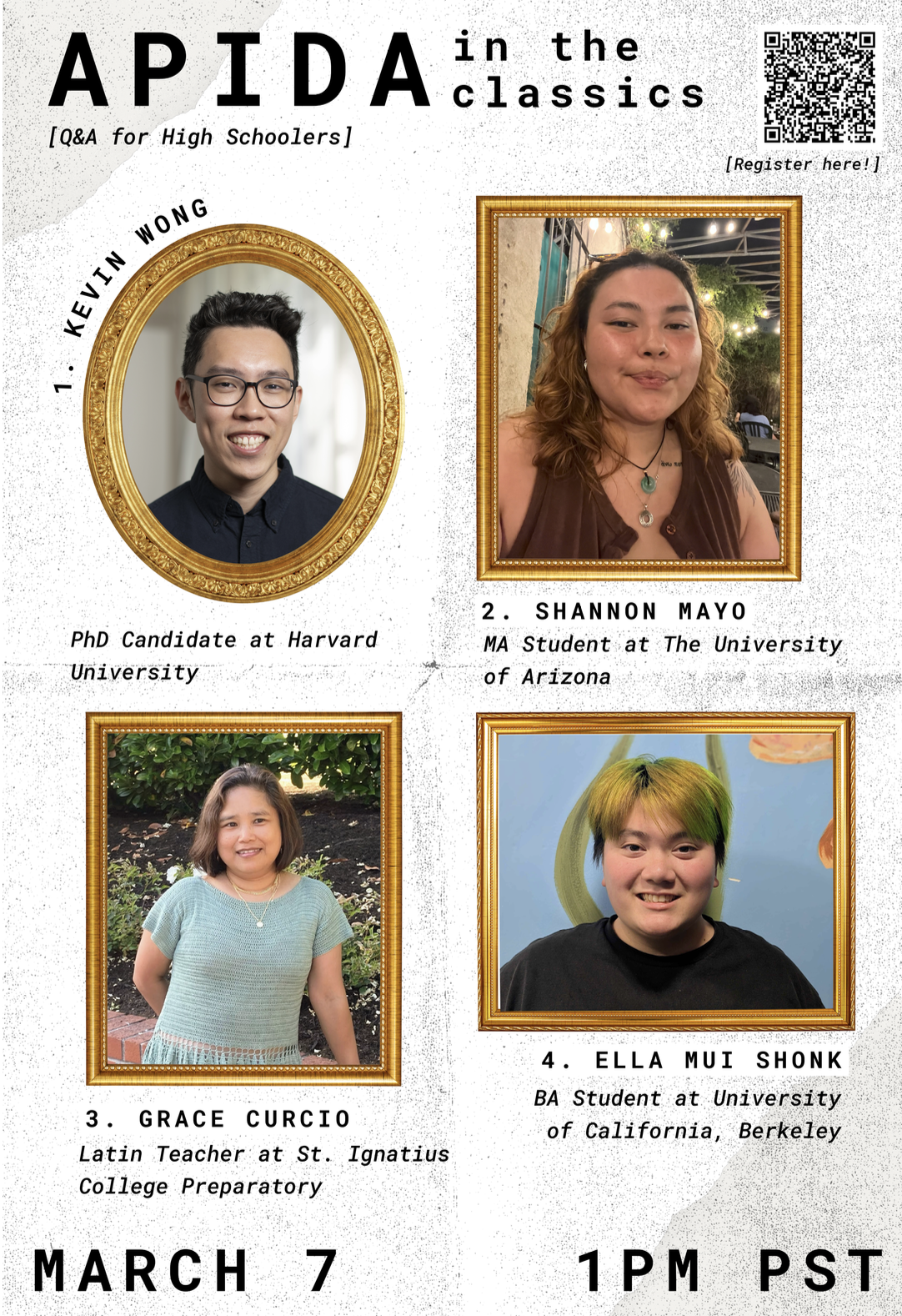
Third Annual APIDA in Classics Event
We invite high school students interested in Classics, particularly those who identify as APIDA (Asian, Asian American, Pacific Islander, and/or Desi American), to register for this free virtual event on Saturday March 7, 2026, 1pm PST/4pm EST. The event will be held on Zoom.
Registered participants will have the opportunity to engage with our panelists at all different levels of education and answer questions about studying Classics, being an APIDA Classicist, and any other questions you might have!
Registration Link: https://forms.gle/Y24KdkYDxkxEQV737
Learn more about our panelists here: https://www.aaaclassicalcaucus.org/newsannouncements/2026/2/24/poe404bzur0xulstls9t1hnl8jortf
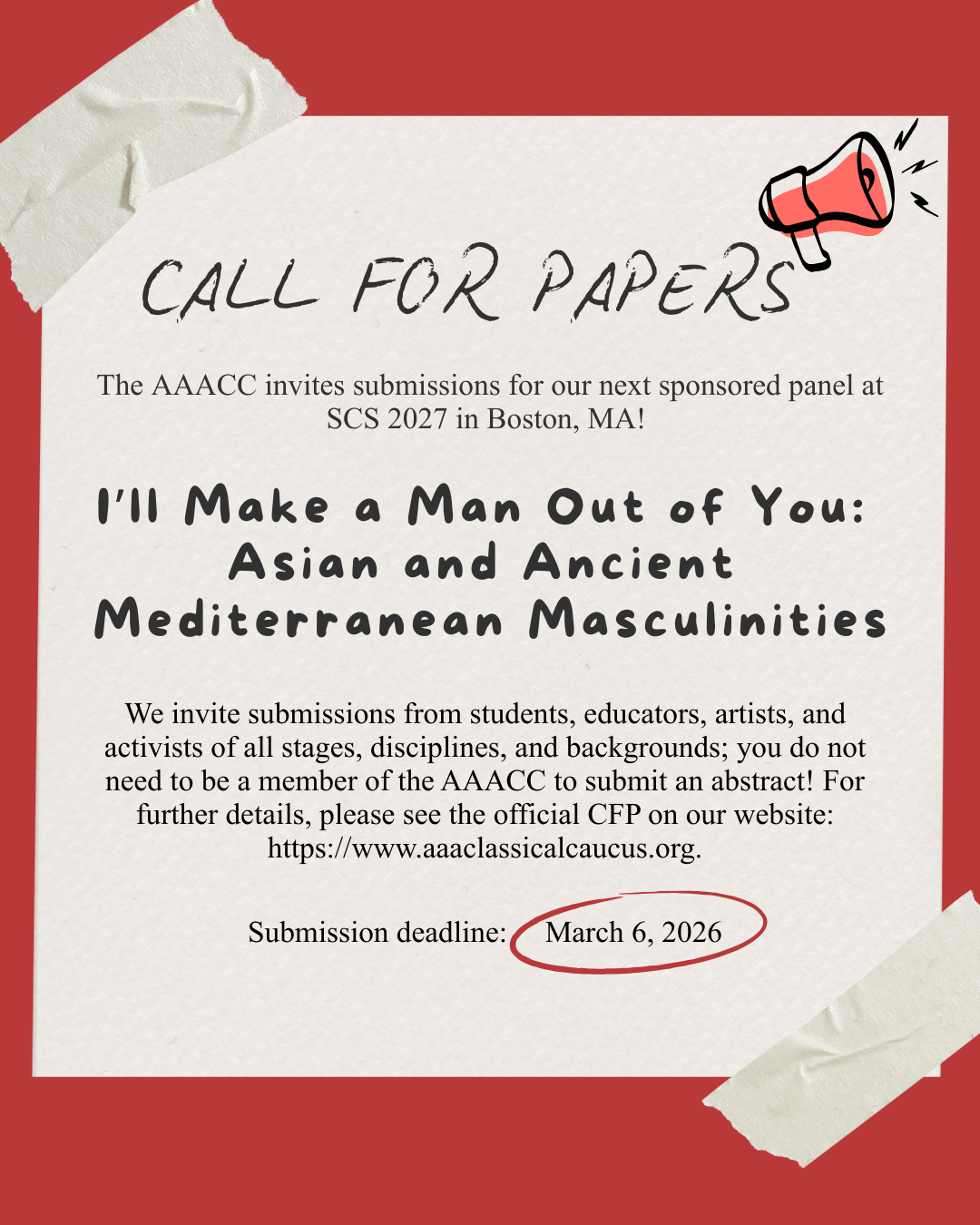
The AAACC invites submissions for our next sponsored panel at SCS 2027 in Boston, MA!
We invite submissions from students, educators, artists, and activists of all stages, disciplines, and backgrounds; you do not need to be a member of the AAACC to submit an abstract! For further details, please see the official CFP below.
I’ll Make a Man Out of You: Asian and Ancient Mediterranean Masculinities
Organizers: Cassandra Tran (Wake Forest University) and Allie Pohler (University of Kansas)
Society for Classical Studies/Archaeological Institute of America Joint Annual Meeting
January 7–10, 2027, Boston, MA
Masculinity in the ancient Mediterranean world was neither a monolithic nor stable category (e.g., Foxhall and Salmon; Hallett and Skinner; Rosen and Sluiter; Rubarth; Surtees and Dyer). The same can be said about the construction of Asian identity and discourses surrounding Asian and Asian American manhood (e.g., Eng; Louie and Low). Across the ancient Mediterranean, we see examples of how masculinity has been negotiated in the gender inversive marriages between the Scythians and Amazons, racialized depictions of Persians in the Greek literary imagination, and the tensions between Trojan ancestry and Italian assimilation in the male-centric foundation myths of Rome. In Asia and Asian America, masculinity has been examined vis-à-vis the racial hierarchy of sexuality and desire in a globalized world (Jung; Lu and Wong), the “yellow peril” stereotype and model minority myth in the “Western” imagination (Lee), and the diffusion of manly virtues through martial arts and samurai culture (Chan; Rouse).
This panel aims to bring Asian studies in dialogue with studies of gender in the ancient Mediterranean. It seeks papers that use comparative methodologies to investigate masculinity—its construction, ideals, intersections, paradoxes, and more—across social status, race, ethnicity, sex/gender, age, and culture. Together, contributors will interrogate how modern colonial, imperialist, Orientalist, and patriarchal frameworks have shaped our understandings of gendered and racialized identities in both antiquity and modernity.
Papers might examine questions and topics such as:
Marginalized and alternative masculinities (including eunuchs, enslaved identities, performers, etc.)
Hypermasculinity vs ‘soft’ masculinity in the presentation of racialized bodies; sexuality as a cultural or social stereotype; trends in representations of manhood in art and literature
Military culture and the performance of masculinity/emasculation through victory/defeat
Representations of fertility and infertility among men in medical texts, literature, and material culture; the impact of gender roles in negotiating male fecundity
Social reproduction and the transmission of masculine values through mentorship and pedagogy
The negotiation of masculinity in the model minority myth and within the context of racial hierarchy
Intersections of race, sexuality, and masculinity
Masculine women or female masculinities; the blurring of femininity and manliness across gender and sex
Abstracts of 400 words or fewer should be submitted as PDF attachments via email to AAACCabstracts@gmail.com by Friday, March 6, 2026. Please use the subject line “AAACC Panel at SCS 2027 Abstract.” The text of your abstract should follow the guidelines available on the SCS website and should not mention the name of the author. Abstracts will be evaluated anonymously by the panel organizers. The AAACC is committed to fostering a collaborative and supportive environment for the sharing of innovative ideas; as such, we welcome submissions from students, educators, artists, and activists of all stages and disciplines. Should you have any questions, please contact the organizers Cassandra Tran (tranc@wfu.edu) and Allie Pohler (alliepohler@ku.edu).
Please note: the organizers will aim to notify authors of their decision as promptly as possible to allow authors whose abstracts are not chosen to participate in the SCS individual abstract submission process.
Works Cited
Chan, J. 2002. Chinese American Masculinities: From Fu Manchu to Bruce Lee. Routledge.
Eng, David L. 2001. Racial Castration: Managing Masculinity in Asian America. Duke University Press.
Foxhall, L. and Salmon, J. eds. 1998. Thinking Men: Masculinity and its Self-Representation in the Classical Tradition. Routledge.
Foxhall, L. and Salmon, J. eds. 1998. When Men Were Men: Masculinity, Power and Identity in Classical Antiquity. Routledge.
Hallett, J. and Skinner, M. eds. 1997. Roman Sexualities. Princeton University Press.
Jung, M. 2025. “Flexible Masculinities: Negotiating Gender, Sexuality, and Ethnicity in Global Asia.” Current Sociology, 73(7) 997–1017.
Lee, R.G. 1999. Orientals: Asian Americans in Popular Culture. Temple University Press.
Louie, K. and Low, M. eds. Asian Masculinities: The Meaning and Practice of Manhood in China and Japan. RoutledgeCurzon.
Lu, A. and Wong, Y. J. 2013. “Stressful Experiences of Masculinity Among U.S.-Born and Immigrant Asian American Men.” Gender and Society, 27(3), 345–371.
Rosen, R. and Sluiter, I. eds. 2003. Andreia: Studies in Manliness and Courage in Classical Antiquity. Brill.
Rouse, W. 2015. “Jiu-Jitsuing Uncle Sam: The Unmanly Art of Jiu-Jitsu and the Yellow Peril Threat in the Progressive Era United States.” Pacific Historical Review, 84(4), 448–477.
Rubarth, S. 2013. “Competing Constructions of Masculinity in Ancient Greece.” Athens Journal of Humanities and Arts 1(1): 21–32.
Surtees, A. and Dyer, J. 2020. Exploring Gender Diversity in the Ancient World. Edinburgh University Press.
Latests News and Announcements


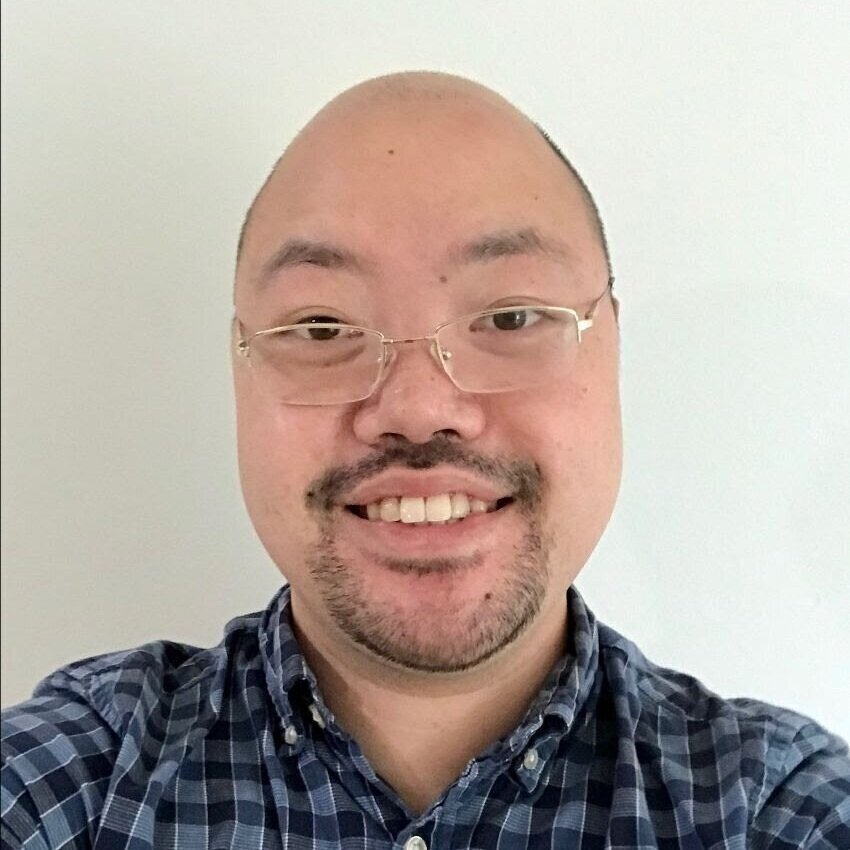


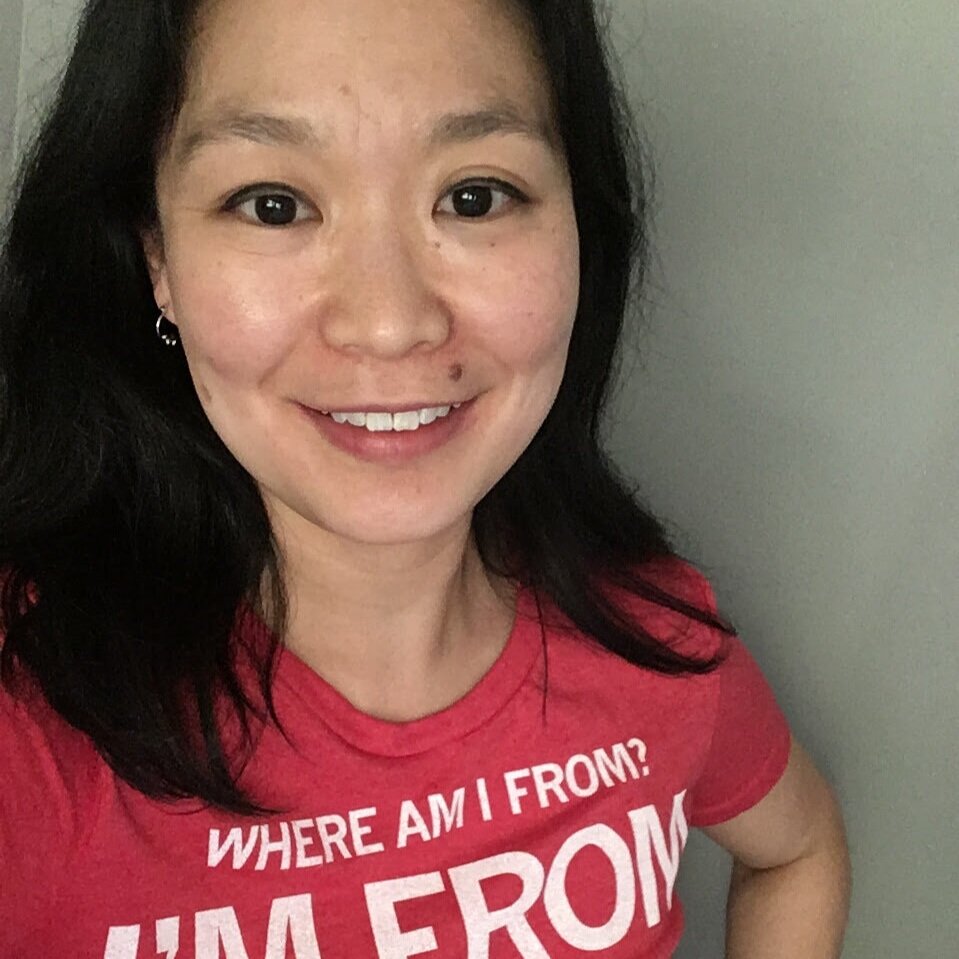
Announcing the AAACC Officers for 2025–2027
Learn more about our new officers here.
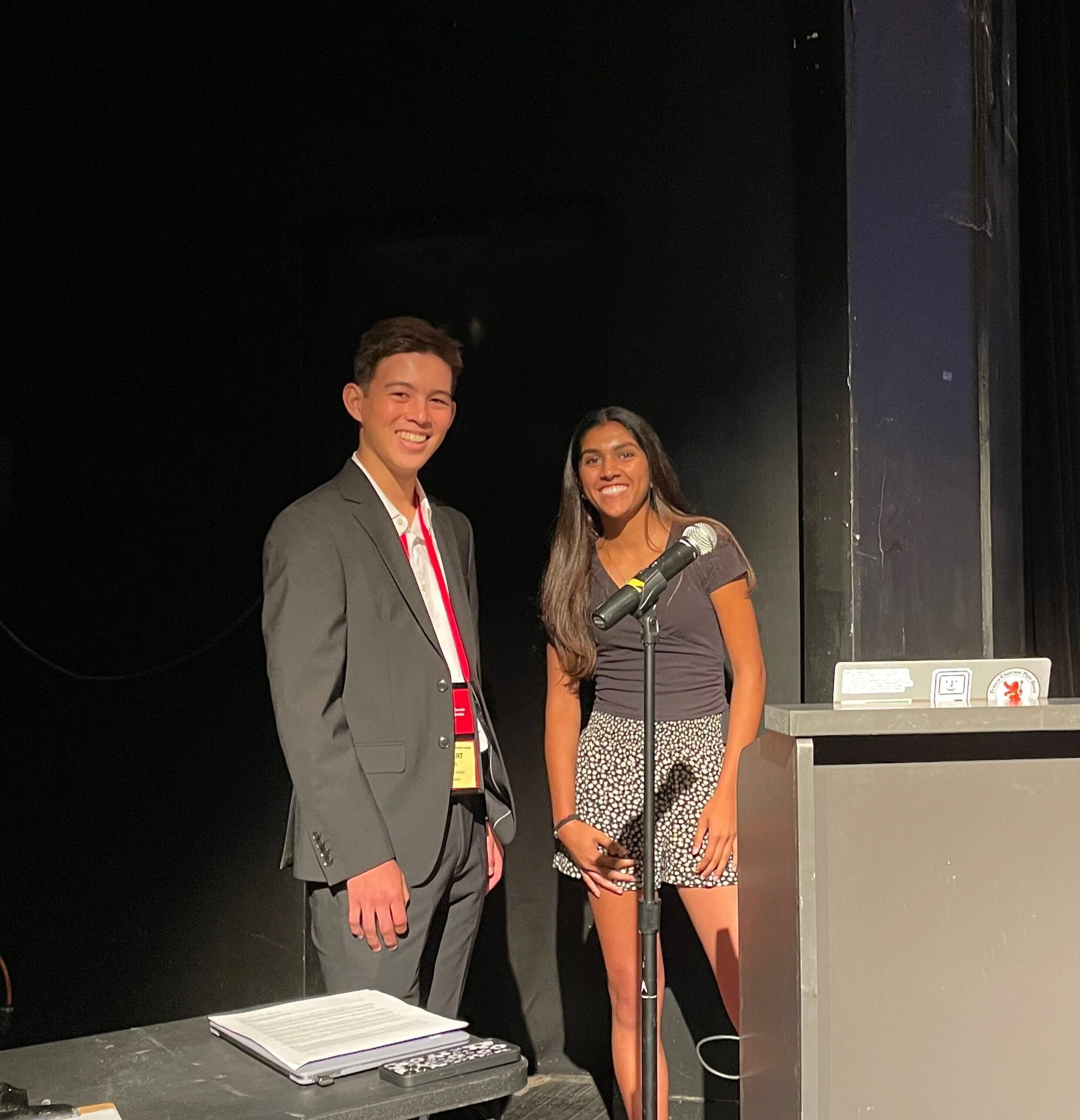
Our two interns, Rupert Chen and Sara Kumar, attended the National Junior Classical League convention in July 2022 and delivered a presentation called “Parallels Between Asian and the Greco-Roman Mythology.” Rupert is a junior at the Harker High School in San Jose, CA and Sara is a junior at the University of Chicago Laboratory High School in Chicago, IL. In their presentation, Rupert and Sara explored the intersection of Greco-Roman mythologies and those of the Asian world. The convergence of these two civilizations is often overlooked. However, their presence within one another is profound. Focusing on specifically the East Asian and South Asian regions, this presentation bridged perceived cultural divides and showed the interconnected nature of the ancient world. Greek and Roman mythology in particular has been popularized for centuries, with deities such as Poseidon and Hercules permeating modern Western culture. However, the similarities between gods such as Duryodhana, the antagonist in a Hindu epic, and Achilles, the hero of the Trojan war, may seem impossible but are deeply present. Rupert and Sara hope to continue to bring new meaning to the study of the classics and prove its relevance to those who may not feel connected to Greco-Roman myths.
Announcing our new Officers (2021–2023)!
The votes are in! Please join us in welcoming the new AAACC officers!
To learn more about the new officers, click here.
Not a member and want to be? Click here.

Co-Chair: Dr. Arum Park

Co-Chair: Dr. Christopher Waldo
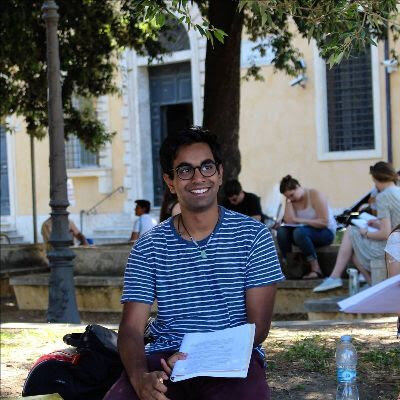
Financial Officer: Ethan Ganesh Warren

Programming Officer: Tori Lee

Outreach Officer: Dora Gao

Secondary Education Liaison: Annie Huynh

Mentorship Coordinator: Helen Wong
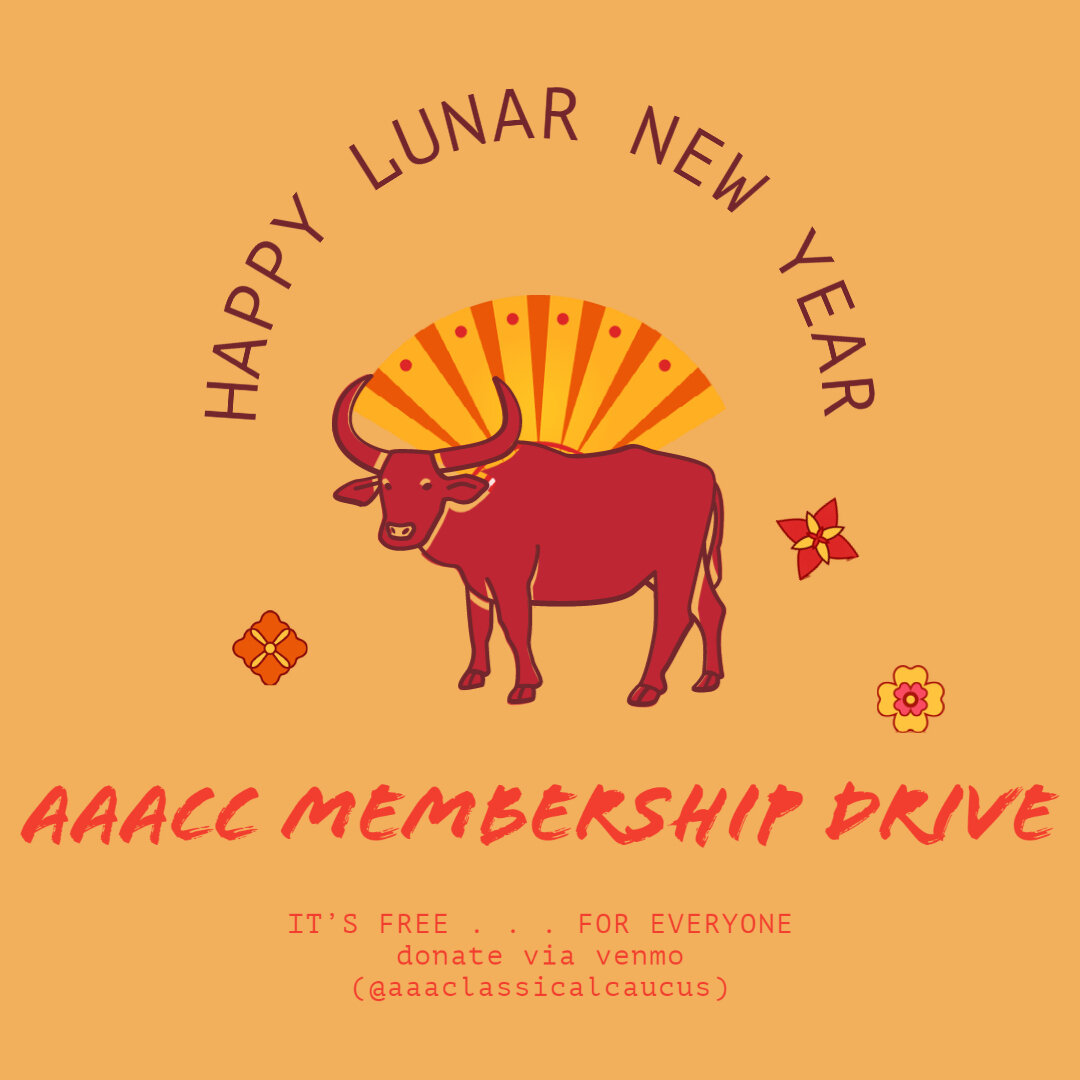
Sign up to be an AAACC member today!
Happy Lunar New Year and welcome to the AAACC’s inaugural membership drive!
You can contribute to our membership drive no matter your employment status. Memberships are FREE and you can donate via Paypal or Venmo (@aaaclassicalcaucus) if you choose.
As a member, you…
gain access to the much-lauded AAACC mentorship program
can attend workshops in career diversity, experimental learning, and
professionalizationsupport rising scholarship in Asian/American classical reception
support grassroots initiatives in BIPOC coalition-building
Donations support the following:
Artist honoraria
Undergraduate paper prizes
Workshop organization
Day-to-day costs of running a nonprofit organization, e.g. website!
We encourage any and all supporters of the AAACC to contribute to our membership drive. Please spread the word!

“Orientalisms”
Organized by Arum Park (U of Arizona) and Stephanie Wong (Brown U)
2022 Society of Classical Studies Annual Meeting
January 5-8, 2022
San Francisco, CA
“Orientalism is a form of paranoia.”1
For our third panel at the annual meeting of the Society for Classical Studies (SCS) in San Francisco, CA (January 5-8, 2022), the Asian and Asian American Classical Caucus invites abstracts for presentations that broadly explore the concept of “orientalism” as applicable to the study of the ancient Mediterranean. As Edward Said articulated, “Orientalism was ultimately a political vision of reality whose structure promoted the difference between the familiar (Europe, the West, ‘us’) and the strange (the Orient, the East, ‘them’).”2 Possible topics include but are not limited to: ancient Mediterranean constructions of difference, Asian and AAPI receptions of Western antiquity, the intellectual history of Classics, Orientalism in pedagogy, or non-Western conceptions of Classical antiquity.
We welcome proposals for diverse forms of interpretation; scholarly papers are always welcome but other proposed formats might include visual or literary art, performance, or discussions of political activism. In an effort to pluralize the definition of orientalism and explore its myriad uses in all geographic antiquities (Eastern, Western, or otherwise) as well as in the present day, we encourage abstract submissions that subvert imperial hegemonies, trouble heteronormative conventions, and question eurocentric ideologies. Who constitutes “us” and “them,” and why must these categories constantly be redefined?
Abstracts of no more than 400 words should be submitted as a pdf email attachment to AAACCabstracts@gmail.com by Friday, March 5, 2021. The subject line of your email should be “SCS 2022: Orientalisms abstract.” The text of your abstract should follow the guidelines available on the SCS website and should not mention the name of the author. Abstracts will be evaluated anonymously by the panel organizers. The AAACC is committed to fostering a collaborative and supportive environment for the sharing of innovative ideas; as such, we welcome submissions from students, educators, artists, and activists of all stages and disciplines.
Should you have any questions, please contact Arum Park (arumpark@arizona.edu) and Stephanie Wong (stephaniewong@brown.edu).
1 Edward Said, Orientalism, 71.
2 Said 42.

Panelists from our inaugural AAACC panel at the 2020 SCS/AIA Annual Meeting.
BLACK LIVES MATTER
We are dedicated to protecting the lives and livelihoods of Black people in both ideology AND material resources.
Here’s how the AAACC has pledged to support the Black Lives Matter movement:
Members of our executive committee have committed to donating to various organizations that directly support the Black Lives Matter movement. We hope you can pledge the same.
Stephanie donated to Unicorn Riot!
Kelly donated to the NAACP Legal Defense Fund and the Bail Project!
Tessie donated to the National Bail Fund Network and Black Visions Collective!
Chris donated to the NAACP Legal Defense Fund and Sportula!
JaShong donated to the Toronto Protestor Bail Fund!
Elizabeth donated to Campaign Zero and ACLU!
Still hungry for thinkpieces and resources?

Scenes from our inaugural AAACC panel at the 2020 SCS/AIA Annual Meeting entitled “Classical Reception in Contemporary Asian and Asian American Culture.”
@aznclassics